
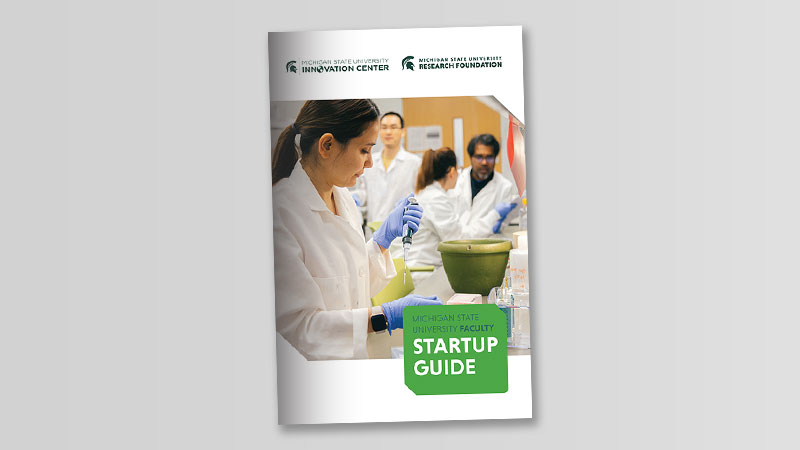
MSU Faculty Startup Guide

MSU Faculty Startup Guide

Whether you’re exploring commercialization for the first time or already leading a university spinout, this guide provides a helpful overview of the people, programs, and resources available to support you.
Michigan State University has a rich legacy of transformational research and innovation. From early medical breakthroughs such as the cancer drugs Cisplatin and Carboplatin to today’s technologies advancing health, data science, and mobility, MSU continues to shape the world. But for many faculty, the path from research to real-world impact can feel complex or distant from their academic work.

Below are answers to some of the most frequently asked questions, along with practical next steps to help move your technology forward:

Journal articles, abstracts, posters, and conference presentations are con-sidered public disclosures, which can affect the timeframe to seek patent protection. Contact MSU Technologies (MSUT) before sharing your findings to help safeguard your rights.

MSUT is the university’s technology transfer office within the MSU Innovation Center. The team works with faculty from every discipline to assess discoveries, determine commercial potential, and guide the protection process.

Disclosing first ensures your intellectual property can be evaluated and, if appropriate, protected before it becomes public—preserving your ability to publish and your potential for commercialization.

NEXT STEPS:
  • Talk with your MSUT tech manager before publishing.
  • Submit an invention disclosure to MSUT.

When discoveries become products or services, they can raise your lab’s visibility, attract new partners and funding, and create hands-on learning opportunities
for students.

As the nation’s premier land-grant institution, Michigan State University was founded to share knowledge and drive economic progress. Commercialization supports that mission by moving research beyond the lab to benefit people and communities.

Startup companies are one way to bridge the gap between discovery and real-world impact. In some cases, promising research is not yet ready for industry adoption, and a startup can provide a focused path to further develop, test, and apply a technology while reducing technical and market risk.

The MSU Innovation Center helps faculty translate discoveries into the private sector, building pathways that bring new technologies to the public.

NEXT STEPS:
  • Explore commercialization options with MSUT or the MSU Research Foundation.
  • Consider how a startup could advance your research.

There are two common paths to bring university research to market: licensing your technology to an established company, or forming a startup to commercialize it yourself. MSU Technologies (MSUT) can help evaluate which path best fits your goals, resources, and the stage of your technology.

Faculty may earn royalties* when technologies are licensed, including to their own startup.

License vs. Startup

LICENSE

  • Leverages an existing company
  • Steady royalties possible*
  • Less time commitment and personal risk
  • Minimal influence on development

STARTUP

  • Builds a new venture
  • Higher returns possible
  • Greater time commitment and personal risk
  • More influence on development

*Royalties are governed by MSU’s Intellectual Property (IP) policy.

NEXT STEPS:
  • Review Conflict of Interest (COI) and Conflict of Commitment (COC) requirements with MSU.
  • Discuss license vs. startup paths with an MSUT tech manager.

The MSU Research Foundation helps faculty form startup companies based on disclosed university technologies. Through mentorship, leadership development, and access to specialized talent, you’ll find the expertise and support needed to build a strong venture team.

  • Mentors-in-Residence (MIR): Experienced mentors who can help create a business model and prepare your venture for launch.
  • Entrepreneurs-in-Residence (EIR): Business professionals with technical backgrounds who can help you identify leadership needs or even serve as a CEO for your startup.
  • Venture Fellows Postdoc: A one-year, funded postdoctoral program designed to help commercialize MSU technologies and strengthen your startup team.
  • Startup Jobs Board: A centralized job board where you can post openings or connect with skilled talent seeking opportunities at Michigan-based startups.
NEXT STEPS:
  • Meet with the MSU Research Foundation to find support, mentors, and leadership talent.
  • Post or explore roles on the Startup Jobs Board.

Commercializing a technology often requires funding to bridge the gap between research and market readiness. MSU and its partners offer a range of funding pathways to help move discoveries toward real-world impact.

Translational Funding: Early-stage grants that support research teams in demonstrating commercial potential, including:

  • ADVANCE Grants
  • MTRAC Grants
  • Tech-Dev Grants

Venture Investment: Capital and strategic support for MSU-affiliated startups, including:

  • Red Cedar Ventures
  • Michigan Rise
  • Henry Ford MSU Innovation Fund

Other Funding Sources: Additional programs that complement or extend early-stage support, including:

  • Federal Grants (SBIR/STTR)
  • Business Accelerator Funds (BAF)
NEXT STEPS:
  • Outline your funding goals and timeline.
  • Review MSU grants and venture funding options.

Once your startup is formed, MSU and its partners provide access to mentorship, education, funding, and collaborative spaces to support growth and long-term impact.

Conquer Accelerator
Cohort-based startup accelerator programs with funding, mentorship, and industry-specific support for technology companies.

Programs & Events
Workshops, conferences, and networking opportunities that support and connect startups across the MSU innovation ecosystem.

Purchase Order Financing
Working capital that helps startups fulfill large orders, manage cash flow, and sustain business growth.

Research Parks
Wet labs, flex offices, and incubator space across Greater Lansing, Grand Rapids, and Detroit.

Henry Ford + MSU Innovation Hub
Connects healthcare innovators with clinical expertise and entrepreneurial support.

NEXT STEPS:
  • Attend a free workshop or networking event.
  • Apply to a Conquer Accelerator or similar programs.
  • Explore space and growth resources in Research Parks.

Quick Reference Guide

The venture world comes with its own language, which can feel unfamiliar to researchers. This quick reference guide highlights common terms you may encounter, helping you navigate the path from discovery to commercialization.

Accelerator

A short-term, cohort-based program that provides startups with mentorship and resources to grow quickly.

Angel Investor

An individual who invests personal funds in an early-stage company, often offering mentorship in addition to capital.

Elevator Pitch

A concise, persuasive summary of a startup or idea—short enough to share in the time it takes to ride an elevator.

Entrepreneur-in-Residence

An experienced business leader who advises or helps lead university-affiliated startups.

Incubator

A shared workspace that provides startups with office or lab facilities, mentorship, and business support as they develop.

Intellectual Property (IP)

Discoveries or inventions that are legally protected by patents, copyrights, or trademarks.

Mentor-in-Residence

An advisor with entrepreneurial experience who guides faculty through commercialization pathways.

Minimum Viable Product (MVP)

The simplest version of a product that can be tested with customers to validate need and gather feedback.

Pitch Competition

An event where entrepreneurs present their ideas to judges or investors to gain feedback, visibility, and potential funding.

Proof of Concept

Evidence showing that a discovery or technology functions as intended and has market potential.

Purchase Order (P.O.) Financing

Short-term funding that enables startups to fulfill large customer orders before receiving payment.

SBIR/STTR

Federal programs that provide funding to small businesses and university-based startups for research and development with commercial potential.

Seed Funding

The first equity investment used to build prototypes, hire early staff, and test the market.

Spinout

A company formed to commercialize technology or intellectual property developed within a university or research lab.

Venture Funding

Investment capital provided in exchange for ownership (equity) to help a startup scale and enter new markets.