SHARE
August 14, 2026
Mobility Summit Focuses on Michigan’s Competitive Edge in a Changing Mobility Economy
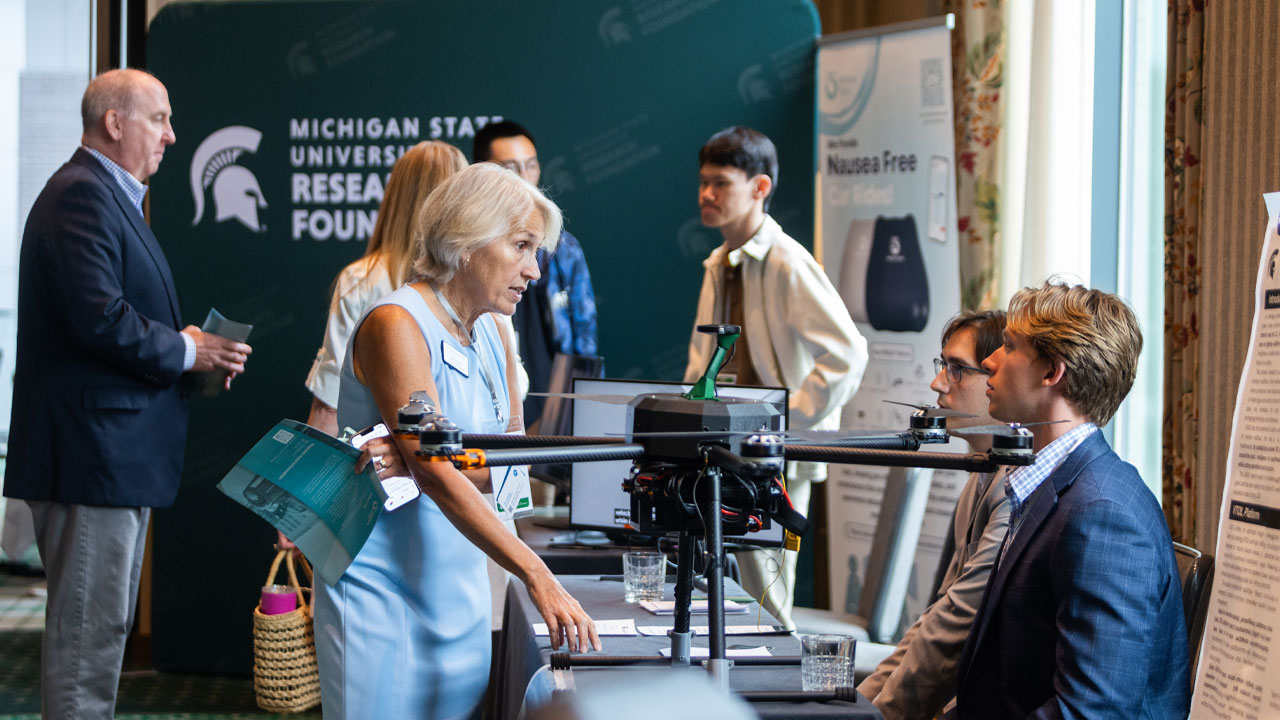
Co-hosted by the MSU Research Foundation and MSU Mobility, the summit drew more than 200 attendees from across Michigan’s mobility ecosystem to address the forces reshaping the industry and the state’s ability to compete.
EAST LANSING, Mich. (Aug. 14, 2026) –– Leaders from across Michigan’s automotive and mobility ecosystem gathered at the Graduate by Hilton East Lansing on August 11 for the 2026 Mobility Summit: Michigan Moves — Building the Next Mobility Economy, co-hosted by the MSU Research Foundation and MSU Mobility.
Supported by Waymo, the Michigan Economic Development Corporation (MEDC) and the Michigan Outdoor Recreation Industry Office, the daylong summit brought together researchers, entrepreneurs, automotive leaders, investors, policymakers, and government partners for conversations spanning autonomous mobility, emerging technologies, defense innovation, and Michigan’s position in an increasingly competitive global industry.
The summit opened with remarks from Judd Herzer, Director of MSU Mobility, who welcomed attendees and introduced Britany Affolter-Caine, Executive Director of Research Universities for Michigan, to set the stage for the opening keynote.
Who Will Build the Future of Mobility?
The keynote fireside conversation featured Dr. Shashank Priya, Vice President for Research and Innovation at Michigan State University, and Jim Quesenberry, Innovation Outreach at Magna International, moderated by David Washburn, Chief Executive Officer of the MSU Research Foundation.
Speakers challenged participants to consider what stronger university-industry partnerships could unlock for Michigan’s mobility sector.
From Prototype to Policy
Autonomous mobility took center stage during From Prototype to Policy: Michigan’s Path to Autonomous Mobility, introduced by Jeff Smith, Executive Director of Research Parks at the MSU Research Foundation and moderated by Justine Johnson, Senior Vice President and Chief Mobility Officer at MEDC’s Office of Future Mobility and Electrification.
Panelists Derek Caveney of Toyota Motor North America, Niall Berkery of Neumo, Michelle Mueller of Michigan Department of Transportation, Emily Frascaroli of Ford Motor Company, and Lara Dailey of Waymo explored the intersection of autonomous vehicles, roadway safety, human factors, infrastructure, public trust, and policy.
Rather than focusing solely on when autonomous vehicles will arrive, the discussion examined what it will take for the technology to be deployed safely and at scale, and how Michigan can leverage its automotive, research, infrastructure, and public-sector assets to help lead that transition.
Research and Emerging Technologies
Three Michigan State University researchers presented technologies ready for industry engagement through rapid research spotlights. Nizar Lajnef, MSU faculty and founder of Infratico presented infrastructure sensing technology; Chengcheng Fang, MSU faculty and founder of Current Collector, highlighted innovations in EV battery current collectors; and Josh Siegel, MSU faculty and founder of AI Mechanic, demonstrated technology that uses a smartphone microphone to diagnose vehicle problems from sound in real time. The session was introduced by Brice Nelson, the director of corporate partnerships at MSU.
The summit also looked beyond ground transportation during Skyward: Michigan in the Air. Moderated by Nicole Noll-Williams, President and CEO of the Capital Region Airport Authority, the conversation featured Surya Congress of Michigan State University, Dakoyta Greenman of Westwood AI, and Mike Bucci of Birdstop, exploring drones, autonomous systems, airport applications, and the barriers to real-world aerial mobility deployment. Brad Garmon of Michigan Outdoor Recreation Industry Office introduced this session.
Built Together: MSU’s Cross-College Model examined how expertise across Michigan State University can support increasingly complex mobility research and commercialization. The session featured Satish Udpa, David Frayer, John Verboncoeur, Jenny Carter-Johnson, and Sri Kalyanaraman. This session was introduced by Sanjay Gupta, co-chair of the Green and White Council at Michigan State University.
Mobility, Defense, and Global Competition
Congressman Tom Barrett kicked off the afternoon sessions with remarks on mobility in national defense and Michigan’s role in World War II, setting the stage for the panel, Arsenal of Democracy: Michigan’s Next Mission. Moderated by John Manza of the MSU Office of Research and Innovation, the panel explored mobility as it relates to national security.
Panelists Talia Marie Sebastian of the U.S. Army DEVCOM Ground Vehicle Systems Center, Dr. Mahmoodul Haq, Chris Thomas of Assembly Ventures, and Parker Boundy, CEO of General Orbit, discussed Michigan’s potential role in dual-use mobility technology, defense manufacturing, federal procurement, applied research, investment, and startup deployment.
Drawing on Michigan’s historic role as the Arsenal of Democracy, the discussion considered what that legacy could mean in the 21st century and what it will take to move emerging technologies from development into defense applications.
The final panel, Michigan’s Supply Chain: Built to Compete, turned toward global competition. Tu Le of Sino Auto Insights opened with an assessment of China’s mobility supply chain and what it means for Michigan manufacturers, followed by a discussion with Chris Nolte of Bloom, Sriram Narayanan of Michigan State University, and Katie O’Brien, General Manager, Purchasing Supplier Development at Toyota Motor North America.
The conversation challenged participants to consider where Michigan can compete globally, what capabilities it must strengthen, and what decisions industry, government, universities, and investors need to make now.
The Summit closed with remarks from David Washburn, CEO of the MSU Research Foundation, who reflected on the day’s conversations and called on attendees to act on the partnerships and commitments made throughout the day.
Designed for Connection
Beyond the stage, structured networking opportunities were incorporated throughout the day, including a lunch hosted by Clean Fuels Michigan. Facilitated lunch tables brought participants together around autonomy, advanced air mobility, clean fuels, workforce, policy, investment, startups, and defense.
An outdoor showcase featured a Waymo Jaguar I-P and a Ford Mustang Mach-E, as well as MSU Drift Drone, rockets from MSU Rocketry Team, Formula 1 race cars from MSU and University of Michigan, a SpartanXpress autonomous bus, and exhibiting companies including Ketchel Axle Systems, Neumo, Motion Sync, the MSU Industrial Training and Assessment Center, Next Energy, EMC Squared Vehicles, Infratico and a variety of small electric vehicles.
The summit also included the Satish Udpa Mobility Awards, named in honor of the founding leader of the MSU Mobility program. Pete Savolainen, Chair of Civil and Environmental Engineering at Michigan State University, was named Faculty Member of the Year, while Jim Quesenberry of Magna International was recognized as Council Member of the Year. The awards recognized their contributions to advancing mobility research, collaboration, and innovation.
Three Key Takeaways from the 2026 Mobility Summit
- Michigan’s Mobility Strengths Need Stronger Connections: Michigan has automotive expertise, university research, manufacturing capacity, startups, and public-sector support, but maintaining a competitive edge will depend on connecting those assets more effectively.
- Deployment is Becoming as Important as Development: Across autonomous vehicles, drones, defense technologies, and university research, discussions repeatedly returned to the infrastructure, policy, partnerships, and capital required to move technologies into real-world use.
- Global Competition is Raising the Stakes: From China’s mobility supply chain to emerging defense needs, the summit underscored that Michigan is competing in a rapidly changing global environment that demands faster commercialization and closer collaboration between industry and research.
To learn more about upcoming summits and events hosted by the MSU Research Foundation, visit msufoundation.org/events.
Latest Posts
September 23, 2026
September 18, 2026