
SHARE
July 28, 2026
How One Cardiologist Is Building a Better Tool for Treating Blocked Arteries
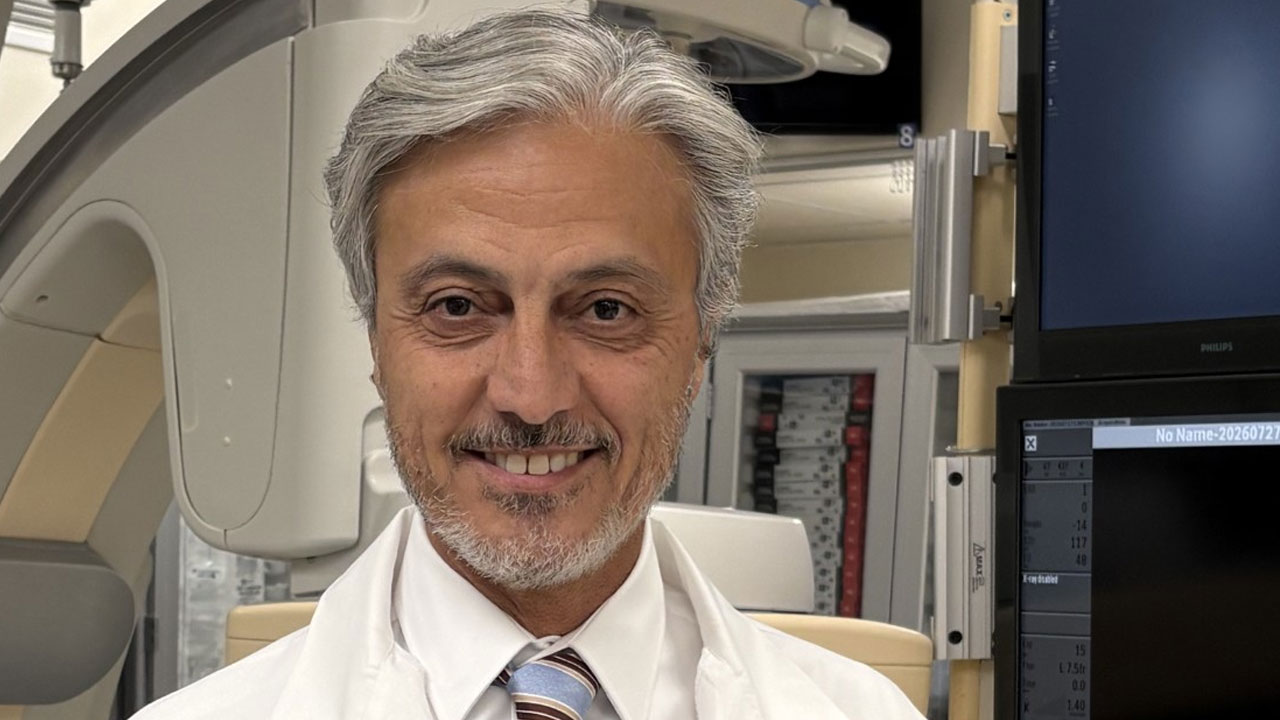
After years of treating patients with some of the most difficult-to-open arterial blockages, Dr. Khaldoon Alaswad founded TruVue to help more physicians perform complex procedures—and bring life-changing care closer to home.
A 47-year-old marathon runner from Michigan was told he might have to stop doing what he loved.
Every time he pushed himself physically, he experienced chest pain caused by a completely blocked coronary artery. His condition wasn’t immediately life-threatening, but it was changing how he lived. Running suddenly felt out of reach.
For Dr. Khaldoon Alaswad, an interventional cardiologist at Henry Ford Health and professor at Michigan State University, stories like this are familiar.
He sees them every week.
Patients who can no longer hike with their spouses. Grandparents who struggle to play with their grandchildren. Active adults who find themselves stopping to catch their breath after walking short distances. In many cases, the cause is a chronic total occlusion—an artery that has become completely blocked over time.
While partially blocked arteries can often be treated using established techniques, chronic total occlusions are among the most technically demanding procedures in interventional cardiology.
“When an artery is completely closed, the procedure becomes much more difficult,” Alaswad said. “There are probably only 40 or 50 people in the entire country who can actually open them with success rates above 90 percent.”
The Challenge Beyond the Blockage
Each year, more than 100,000 patients in the United States undergo treatment for chronic total occlusions. Many more never receive care at all.
For patients whose symptoms aren’t immediately life-threatening, the tradeoff can feel difficult to justify. Some choose to live with the symptoms. Others decide the travel, wait times, or complexity of treatment isn’t worth it.
But the impact on daily life can be significant.
Patients may give up activities they once enjoyed. Walks become shorter. Hobbies become harder. Simple routines require more planning. Over time, many begin adapting their lives around the condition.
“Patients care about quality of life,” Alaswad said. “They deserve to do the things they enjoy doing.”
That reality led Alaswad to a question: What if more physicians could successfully perform these procedures?
Turning Expertise Into Technology
The idea behind TruVue emerged from years spent treating some of the most complex cardiovascular cases in the country.
Current procedures rely heavily on X-ray imaging, which provides physicians with a two-dimensional view of the blockage. When navigating a completely blocked artery, determining the correct path forward can be challenging.
Alaswad believed better visualization could help. His idea was to place a miniaturized ultrasound system inside the catheter itself, allowing physicians to see the artery from within and guide treatment with greater precision.
The concept became the foundation for TruVue, a medical device designed to help physicians visualize the artery’s true pathway and advance guide wires more precisely during these procedures using X-ray and ultrasound imaging. By improving physicians’ ability to treat blocked arteries, the technology could make one of cardiology’s most technically demanding interventions easier to perform consistently while expanding access to treatment.
“If more physicians can perform these procedures successfully, more patients can receive care in their own communities,” Alaswad said.
Building a Company Around a Clinical Problem
Turning that vision into reality required far more than a clinical insight.
After disclosing the invention through Henry Ford Innovations, Alaswad began working with engineers, patent attorneys, and product development specialists to transform the concept into a functional device. What started as an idea on paper evolved into patented technology, working prototypes, and a series of laboratory and preclinical tests.
To support that work, Alaswad and his collaborators formed TruVue and began raising capital to advance development. Along the way, the company received support from Henry Ford Innovations and Michigan Rise, a venture investment subsidiary of the MSU Research Foundation.
That support helped the team continue development as the technology advanced through patenting, prototyping, and testing.
“They paid for the launch, and that was very important and instrumental in us getting this project off the ground,” Alaswad said.
Today, TruVue continues to advance through development and testing as the company works toward future regulatory and clinical milestones.
Making Specialized Care More Accessible
For Alaswad, the long-term vision extends beyond a single device.
If successful, TruVue could help more physicians perform complex procedures that currently require highly specialized expertise. That could mean shorter travel times, more treatment options, and improved access for patients who live far from major medical centers.
The marathon runner from Michigan eventually received treatment and returned to running. Other patients have returned to hiking, traveling, and spending time with family.
Those outcomes remain the motivation behind the work.
As TruVue continues development, the company is working toward future testing and regulatory milestones aimed at bringing the technology closer to physicians and patients.
“Patients will be able to get their treatment safer and in their local communities,” Alaswad said.
For the hundreds of thousands of people living with chronic arterial blockages, making that care more accessible could mean the difference between adapting life around a condition—and returning to the activities that make life meaningful.
Latest Posts
September 8, 2026
September 4, 2026
September 2, 2026