SHARE
October 21, 2026
Data Science + AI Summit Brings a Human Lens to the Future of Agentic AI
Hosted by the MSU Research Foundation and sponsored by Google Cloud, the summit convened researchers, startups, and industry leaders to explore practical AI use, workforce change, and responsible adoption
EAST LANSING, Mich. (Oct. 21, 2026) — More than 200 researchers, startups, investors, and industry leaders gathered at the Graduate East Lansing Hotel for the Michigan State University Research Foundation’s 2026 Data Science + AI Summit, sponsored by Google Cloud.
This year’s theme, “From Hype to Proof – Agentic AI in Practice,” focused on a shift already underway. Agentic AI systems can increasingly move beyond generating information to take action, complete tasks, and influence decisions, raising new questions about where the technology creates value and how organizations use it responsibly.
“Some of the best ideas start by sitting down over a meal or a cup of coffee with someone who sees the world a bit differently,” said Anum Mughal, director of strategic initiatives at the MSU Research Foundation. “We host these summits because we want people who may not normally cross paths to learn what others are working on, find where their interests overlap, and leave with a reason to keep the dialogue going.”
Bringing those perspectives together is central to the summit. The Foundation hosts networking events throughout the year to connect MSU researchers and students with startups and industry leaders, opening the door to new relationships and collaborations that can bring companies closer to campus.
David Washburn, CEO of the MSU Research Foundation, welcomed attendees, followed by a recorded message from U.S. Senator Gary Peters on how cross-sector collaboration can strengthen innovation. From there, the day moved between big-picture questions and real-world applications. Keynotes and panels explored where AI is creating measurable value, while live demonstrations and facilitated conversations gave attendees opportunities to see the technology in practice and learn from one another.
Experiencing AI at Work
The day opened with a keynote from Nurtekin Savas (PayPal) on moving AI investments from experimentation to scale, followed by conversations featuring Callahan Coplai (NVIDIA), Tom Munley (Analytics8), Anjana Susarla (MSU Broad College), and Soma Venkat (Cooper Standard) about where AI is already creating value.
The Applied AI Showcase gave attendees a closer look at technologies being used today, including:
- ConStrat AI, using AI to help construction businesses track finances, monitor cash flow, and assess risk.
- Scalable AI, helping mid-sized manufacturers automate repetitive work across business functions through AI agents that connect with existing systems.
- KindKatch, combining personalized communication with AI-powered conversations to help fitness and wellness businesses engage leads and members.
- SarAI, a text-based AI assistant that helps people manage schedules, reminders, goals, and everyday tasks.
Aerogen Systems, SpartaHack, and TechSmith, also showcased additional applications spanning semiconductor manufacturing, student-led technology projects, and tools for instructional and training conteny.
MSU engineering student Krish Wadhwani displayed a project that uses FaceTime-style calls with a physical character inside a 3D world to support safer communication with children. The project was developed with guidance from Arun Ross (MSU), Anil K. and Nandita K. Jain endowed professor, and Karthik Nandakumar (MSU), associate professor of computer science and engineering, highlighting how students are applying emerging technology alongside faculty expertise.
The conversation continued during “Applied AI Proof Points: What’s Working Now,” where Joe Dearman (TechSmith), Emmanuel Dorley (ConStrat AI), Shawn Kale (Snowflake), and Josh Ross (Scalable AI) shared what organizations are learning as they put AI into practice.
Keeping People at the Center
As the day continued, speakers dove into what greater AI capability means for trust, work, governance, and human decision-making.
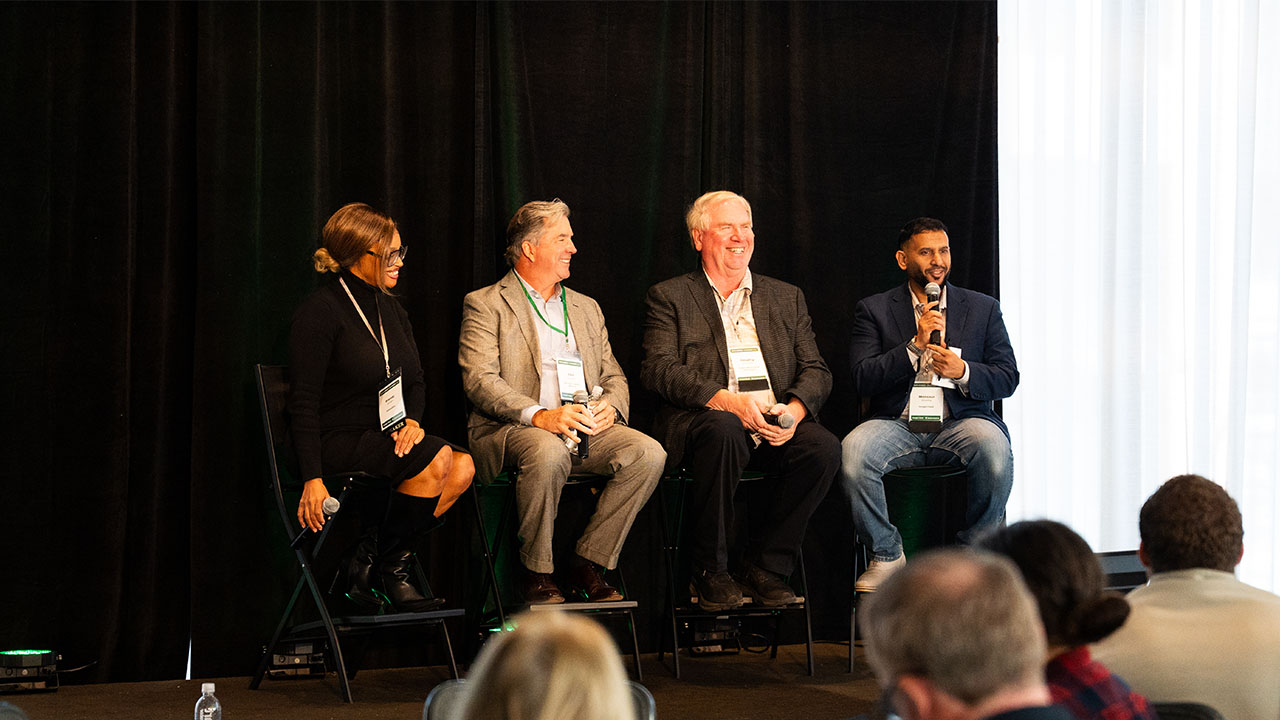
The session “When AI Can Act: Security, Permission and Accountability” brought together Brandy Brown (StrataView), Dale Grogan (Michigan Capital Network Ventures), Timothy Grotjohn (Great Lakes Crystal Technologies), and Mansour Sharha (Google Cloud) to examine questions around AI systems that can increasingly act on behalf of people and organizations.
Later, Tara Behrend (MSU) and Michael Horrigan (W.E. Upjohn Institute for Employment Research) explored how AI could reshape work and the skills people need. Jonas Becker (MSU), Yansong Pei (MSU), and Jianrong Wang (MSU) also shared research moving toward real-world applications.
The summit closed with Ilan Rubinfeld (Henry Ford Health), Mohammad Ghassemi (MSU/Ghamut), and Sunny Nadolsky (BridgeCare) discussing trust when AI influences decisions that affect people.
Putting Real Challenges on the Table
The summit also gave attendees space to work through questions from their own organizations.
During the “AI Challenge Corners Lunch,” Sanjay Baskaran (AlumX), Chris Ahn (Deloitte), Chris Daugherty (Internet2), Callahan Coplai (NVIDIA), Nurtekin Savas (PayPal) and Shawn Kale (Snowflake) led small-group conversations around challenges organizations are facing right now.
Participants discussed everything from outdated infrastructure and data readiness to changing workplace expectations. Other conversations focused on trust, human oversight, and how organizations can give AI more responsibility while maintaining clear boundaries.
Two rounds of “Meet Your Collaborators,” facilitated by Tomasz Cwik, mentor-in-residence at the MSU Research Foundation, gave attendees additional opportunities to compare ideas and build connections across industries.
“We want the conversations that start here to help people see where their work and ideas might intersect,” said Mughal. “These meaningful connections can lead to a next step, whether that’s a research collaboration, a capstone project, a pilot, a new partnership, or simply another conversation to move an idea forward.”
Four Key Takeaways from the Data Science + AI Summit
- Stay curious and keep questioning.
People can be enthusiastic about AI while still approaching it critically. Understanding what the technology can and cannot do remains essential as its role grows. - Keep people in control.
Trust grows when people can verify AI recommendations, step in when needed, and remain accountable for the final decision. Clear boundaries and thoughtful oversight are important as systems become more autonomous. - Rethink how work gets done.
As AI takes on more execution-oriented tasks, human curiosity, creativity, and critical thinking become even more valuable. Organizations can build on AI’s efficiencies by giving people more time and space to learn and adapt. - Get the basics right first.
Organizations still need reliable data, modern infrastructure, and clear security practices before they can use AI effectively. Many of the biggest barriers to adoption begin well before an organization chooses an AI model.
The conversations throughout the day reflected the value of bringing people with different experiences into the same room. Connections built through the summit series and related MSU Research Foundation events have already grown into Google Cloud collaboration, capstone projects, startup-faculty partnerships, and new conversations around research and office space.
“There’s incredible work happening across Michigan’s innovation ecosystem,” said Washburn. “We’re always thinking about what resources researchers and entrepreneurs need next to go further. Our role at the Foundation is to create the pathways and connections that give strong ideas room to grow.”
To learn more about upcoming summits and events, visit msufoundation.org/events.
Latest Posts
October 1, 2026