
SHARE
April 28, 2026
Conquer Accelerator Marks 10 Years of Building High-Tech, High-Growth Companies
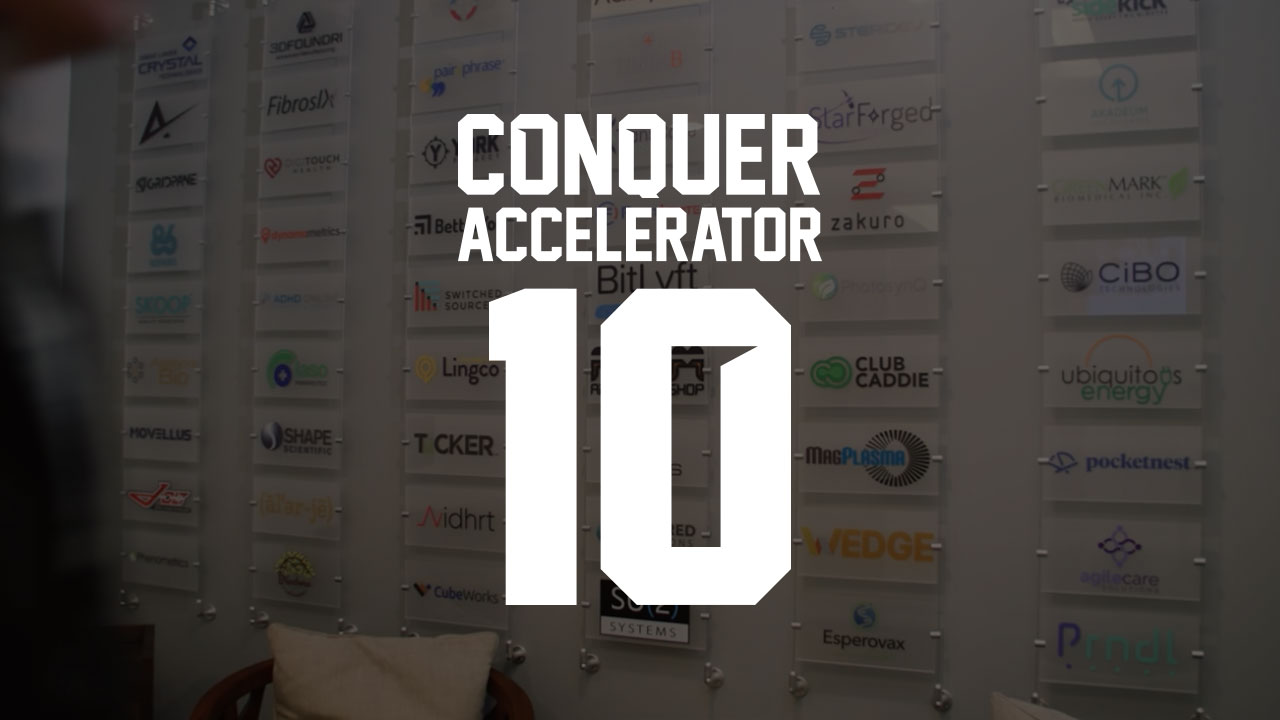
The MSU Research Foundation program has supported more than 100 startups across Michigan, helping founders move from early concepts to scalable ventures.
In 2012, Jason Pearsall, a lawyer with a passion for the game of golf, sold his e-commerce company and invested in Flushing Valley Golf Club in Flushing, Michigan.
Pearsall and his team—the golf professional and general manager—set out to transition the private club into a public golf course. When members pushed back, they landed on a compromise: a semi-private model.
“This meant we were open for public play, but we still had memberships and all the community that a private country club has, and that posed a lot of technology challenges for us,” Pearsall said.
At the time, existing software systems were built either for traditional private clubs or fully public courses. There wasn’t a solution designed to manage both.
“We started building a solution for our own club in 2015 and we knew that if we were going to invest in building it, we needed to build it as a multi-tenant enterprise we could eventually offer to others,” Pearsall recalls.
They named the company Golfler, which was later rebranded as Club Caddie.
Pearsall found himself owning a golf course, running an early-stage company, and scaling a SaaS business—all new experiences for him.
“Most people don’t realize just how lonely and how difficult it is to be a founder,” he said. “You’re trying to raise capital, self-fund the company, or bootstrap it, sometimes without the resources you need to be successful.”
Conquer Accelerator Provides Structure and Development Opportunities
In 2016, Pearsall turned to the MSU Research Foundation’s newly formed Conquer Accelerator, designed to support Michigan State University student entrepreneurs through funding, targeted curriculum, hands-on coaching, and access to investors and advisors.
According to MSU Research Foundation CEO David Washburn, the idea for the accelerator started in 2015.
“The goal was to launch a summer accelerator program in East Lansing that filled a gap in the entrepreneurial life cycle for student startups,” Washburn said.
At the time, the Foundation operated incubator spaces in East Lansing, including The Hatch and The Hive, where students explored early-stage ideas and potential business concepts.
“Students would come in with an idea for a product or service and start thinking through what it could become,” Washburn said. “The Conquer Accelerator was a way for us to identify the most promising teams and help them move forward.”
Each year, a small cohort was selected for a 10-week program focused on refining their business models and building toward launch. Teams worked through core areas such as product development, customer discovery, go-to-market strategy, and fundraising.
At the end of the program, each team received a $20,000 investment from Red Cedar Ventures, a venture investment subsidiary of the MSU Research Foundation, and presented at Demo Day, pitching to judges and other potential investors.
Paul Jaques, Managing Director of Venture Creation at the Burgess Institute for Entrepreneurship & Innovation, initiated the program.
“At that point, we were thinking of getting into other accelerators around the country and the world,” Jaques remembers. “I said, ‘Why don’t we just start our own?’”
The Accelerator Begins its 10-Year Journey
Jaques turned to Craig Brown, an MSU alumnus who was the chair of the MSU Research Foundation’s board and had experience working with accelerators on the East Coast. With Brown’s insight and additional research into similar programs, Jaques launched the Conquer Accelerator in 2016.
“The student teams that we worked with had a minimal viable product—an actual idea that was somewhat fleshed out,” Jaques said.
Jaques and his team initially met with the young entrepreneurs daily, then weekly, helping them refine their ideas and identify funding and resources needed to move forward.
“We would push them hard, giving them the homework and tools to work on that would lead to a successful Demo Day at the end of the summer,” Jaques said.
Now, ten years later, Pearsall—part of the first cohort—credits the Conquer Accelerator with helping shape the trajectory of Club Caddie, which he sold to a public company in 2020.
“We’re the market leader in our vertical and have been growing by 35 to 45 percent every year for the last five years,” he said. “And we’re now over $10 million in revenue and adding another $3 million or so every year.”
Bespoke Experiences for Students and Beyond
Tom Stewart, Director of Venture Programming at the MSU Research Foundation, currently leads the Conquer Accelerator. He points to the program’s emphasis on tailored, hands-on support as a defining feature.
“We do what I would call just-in-time coaching,” Stewart said. “We try to be the through line—like a personal trainer for your business—meeting entrepreneurs where they are and creating a bespoke experience for each company.”
Since its early focus on student entrepreneurs, the program expanded to support more faculty-led startups. At the same time, student-focused programming became more closely aligned with Michigan State University through the Burgess Institute for Entrepreneurship & Innovation.
Over time, the program has evolved to align with leading accelerator models. The Conquer Accelerator provides an in-depth look at the key areas required to build a successful company, and includes programs in East Lansing, Grand Rapids, and Detroit, along with sector-focused programs in EdTech, FinTech, and HealthTech.
To date, more than 100 startups have graduated from the Conquer Accelerator, contributing to a portfolio of 262 companies managed by the MSU Research Foundation—now the most active early-stage investor in Michigan through its Red Cedar Ventures and Michigan Rise venture investment subsidiaries.
Regardless of location or sector, Stewart said the focus remains consistent.
“We’re interested in high-tech or high-growth companies that can build a better mousetrap,” he said.
A Better Mousetrap—for Pets and Their Owners
During the COVID-19 pandemic, Rachel Berkal saw a problem firsthand and decided to solve it.
“Penny, our first dog, was terrified of the vet, and the vet was expensive and inconvenient for me as well,” Berkal said. “I’d have to leave work to take her to the vet, and walk out with a $600 bill.”
At the same time, Berkal was watching the rise of convenience-based services, from concierge health care to home delivery for groceries. She began to see a gap in veterinary care, especially for pets with anxiety and owners with limited mobility.
“That could make going to the vet a pretty daunting task,” Berkal said. “So we realized we could apply some of these same principles to veterinary medicine.”
In 2022, Berkal partnered with her fiancé Sadoc Paredes, his sister Ruby Paredes, and veterinarian Brad Boike to launch Vetr Health in Grand Rapids, offering in-home veterinary services, supported by telehealth, and an online pharmacy.
In 2023, the team moved into The Bridge, a business incubator in downtown Grand Rapids operated by the MSU Research Foundation, where they learned about and later participated in the Conquer Accelerator.
Berkal said one of the program’s strengths is its flexibility.
“This was good, because unlike some other accelerators, you didn’t stop the work you’re doing to focus on something else,” she said. “That can be a distraction that slows you down.”
The company is now focused on productizing its software platform for other mobile veterinary practices.
Conquer Accelerator Provides Long-Lasting Relationships
Like Berkal, Michelle Winterfield and her co-founder Dan Couvreur built their company, Tandem, based on their personal experiences—specifically, the challenge of managing finances as a couple without fully combining accounts.
“There’s kind of this gray area for couples who are living as a combined household, but not quite ready to combine finances,” Winterfield said. “We wanted to eliminate the back and forth of mobile payment services without requiring a joint account.”
Early on, as the team was raising venture funding, they learned about the Conquer Accelerator program. After connecting with Tom Stewart, they decided to apply.
“It was early in our company, so it was really nice to have some organization and a kind of forcing mechanism to really think through our business model, financials, and how we would hire and construct our team,” she said. “We still stay in touch with Tom and people from our cohort. It’s been a very long, lasting, and fruitful relationship.”
Berkal described a similar experience.
“We still consider the MSU Research Foundation and the Conquer Accelerator team to be close advisors,” she said. “Those relationships still exist today.”
Ten years in, that may be the clearest measure of the Conquer Accelerator’s impact: not just the companies it helps launch, but the relationships that continue to shape them and the ripple effects those companies create as they grow.
For more information about the Conquer Accelerator programs, visit: msufoundation.org/conquer-accelerator
Written by Rich Keener.
Latest Posts
September 8, 2026

September 4, 2026
September 2, 2026