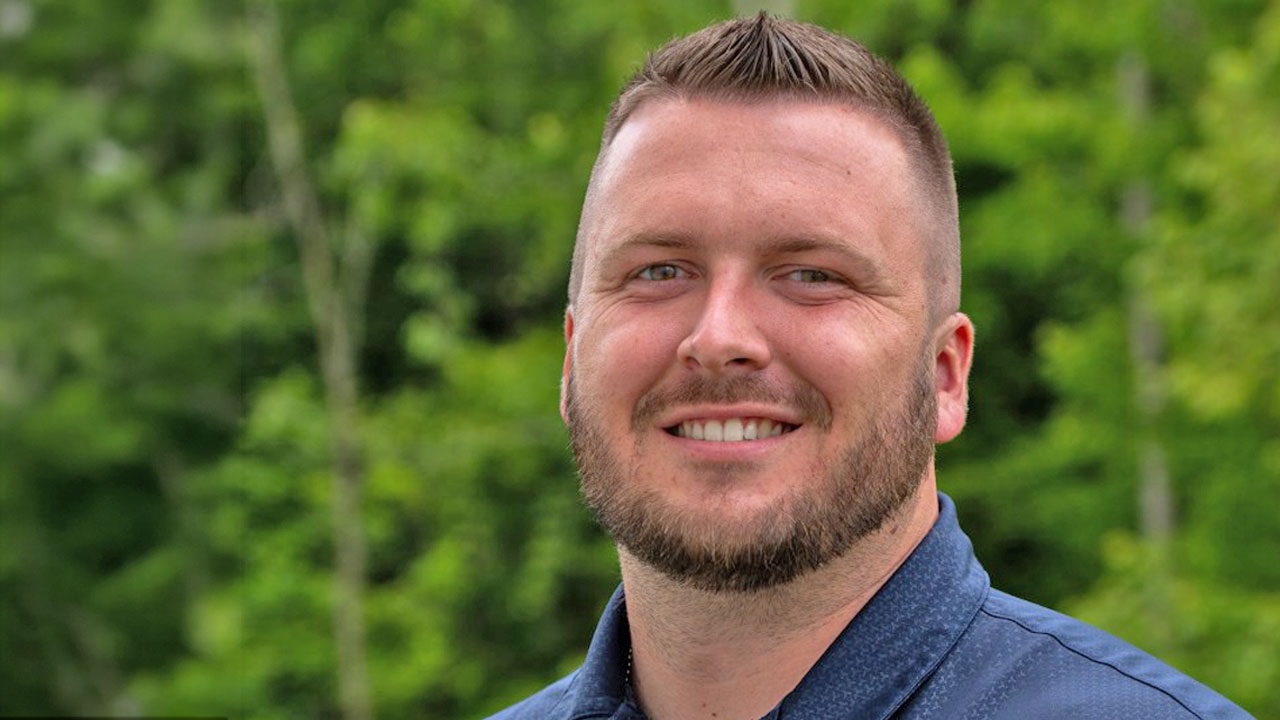
David Washburn
Welcome to the MSU Research Foundation podcast. Today I’m joined by Nick Farina and Johannes Pollanen of EeroQ. We had a really fun conversation about quantum computing, and I think you’ll enjoy it.
My guests today are Nick Farina and Johannes Pollanen of EeroQ. Professor Johannes Pollanen is the Cowan Professor of Physics at Michigan State University and an entrepreneur. Nick Farina is the CEO of EeroQ.
As a reminder for listeners, the MSU Research Foundation—through Red Cedar Ventures—is an investor in EeroQ, but nothing in this conversation should be taken as investment or legal advice.
Welcome to both of you—and thanks for being here.
Johannes Pollanen
Thanks for having us.
Nick Farina
Yeah, thank you, Dave.
David Washburn
Nick, let’s start with you. Where are you from, and how did you get involved with EeroQ?
Nick Farina
Those two things are actually connected. I’m from Chicago—and that’s where I first met Johannes. I was on the board of his wife’s theater company while he was working on his PhD at Northwestern, and at the time, I was running a software company.
One day at a social gathering, he started telling me about what he was doing with electrons on superfluid helium. And I was sitting there thinking, I spend all day writing software—and this guy is manipulating matter at the coldest temperatures known to man. That just seemed way cooler than what I was doing.
It planted the seed. I thought, maybe one day I could be part of something like that.
David Washburn
And Johannes, you earned your PhD at Northwestern, did a postdoc at Caltech, and eventually came to Michigan State. Tell us about that journey.
Johannes Pollanen
Caltech is where I really got immersed in the quantum computing world. I was trained as a condensed matter physicist, studying extremely fundamental behavior in quantum systems.
I remember being a PhD student and having to explain to family members that I was studying something that about 17 people on Earth cared about.
David Washburn
And Nick was one of them.
Johannes Pollanen
Exactly—Nick was definitely one of them.
When I got to Caltech, I joined the Institute for Quantum Information and Matter, which was one of the earliest major research centers focused on quantum computing. That’s when it really clicked for me that we weren’t just understanding nature anymore—we were at a point where we could engineer it.
When I came to MSU, I started thinking seriously about how we could push quantum computing forward. The “electrons on helium” system was actually developed here at MSU by my colleague Mark Dykman. He encouraged me to pursue it.
I never imagined becoming an entrepreneur—but knowing Nick made that possible.
David Washburn
Did Richard Feynman really kick all of this off?
Johannes Pollanen
He was one of the first to seriously talk about modeling nature with quantum machines, back in the 1980s. But interestingly enough, the quantum foundation came even earlier—from John von Neumann.
Classical information theory came from Claude Shannon, but quantum information theory predates that. Feynman’s contribution was connecting it all to real physical systems and technology.
Now we’re at a point where it isn’t just theory—we can actually engineer quantum systems.
Nick Farina
A lot of people assume quantum computing was “invented” in 1985. The truth is, its roots go back much farther.
David Washburn
There are lots of approaches to building a quantum computer. What makes EeroQ’s architecture different?
Johannes Pollanen
We trap electrons in vacuum above a chip coated with superfluid helium. That helium layer shields the electrons from noise and interference.
An electron floating in vacuum is about as pristine a quantum system as you can get. We use the electron’s spin—the tiny magnetic field it carries—as our qubit.
But what really sets our system apart is scalability.
We integrate directly with CMOS—the same manufacturing technology used to make chips for laptops and phones. That’s how traditional computing reached billions of transistors on a single processor. Quantum computing needs the same thing: scale plus quality.
Many teams start with a great qubit and hope scaling works later. We flipped that. We started with scalability first—because without that, you don’t have real-world computing power.
We’re aiming for monolithic integration: millions or billions of qubits on a single chip.
Nick Farina
From a business perspective, that’s what made this compelling. Other approaches have strengths and weaknesses. This system is earlier—but it doesn’t come with built-in limitations.
When people ask for performance numbers like coherence time or gate fidelity, the honest answer is: we’re still building the system.
But the theory behind it has been studied for over 20 years—including right here at MSU—and everything so far suggests it’s an ideal system to build a quantum computer.
David Washburn
So what problems will quantum computers solve first?
Johannes Pollanen
The most exciting ones, in my opinion, are materials science and medicine.
Molecules are quantum systems. So simulating them on quantum computers is a natural fit. That opens the door for better drugs, better batteries, and better manufacturing.
We don’t know exactly when major breakthroughs will arrive—some think thousands of qubits, others think millions. But once we reach large-scale error correction, capabilities will expand dramatically.
Cybersecurity might come first. But designing new materials and medicines—that’s what I’m excited about.
David Washburn
Are you working with application developers?
Johannes Pollanen
We talk with them constantly—but we don’t build applications. Our focus is 100% on hardware.
Quantum computing has many moving parts—hardware, software, algorithms, error correction—and each of those is difficult on its own. Trying to do them all would be reckless.
We believe the industry moves forward through collaboration.
Nick Farina
We spend time learning from application developers—but we stay focused on building the chip. That’s it.
When we started this company in 2016, there was no ecosystem. Today, every major tech company is involved.
Back then, if you told me quantum computers would be in the cloud by now, I wouldn’t have believed you.
David Washburn
How did you fund this early on?
Nick Farina
We self-funded at first.
One thing I learned from startups is: once you take venture capital, the clock starts ticking. You’ve got five years to build something massive.
So instead of rushing, we de-risked the science through sponsored research at MSU. For several years, we worked collaboratively with MSU researchers before ever raising venture money.
That gave us a clear technical path—and credibility.
Johannes Pollanen
Nick predicted early on that once the tech matured, an ecosystem would appear around it.
And that’s exactly what happened.
David Washburn
Why Chicago?
Johannes Pollanen
Talent, first and foremost.
We’re lucky to have world experts in this technology—and many were already based in Chicago. Between Northwestern, UChicago, Argonne, and Fermilab, there’s a continuous pipeline of talent.
Nick Farina
Capital access has also shifted. COVID changed everything.
Now investors are comfortable investing from anywhere. Chicago is deeply connected to the global capital market. And we’ve seen that firsthand.
David Washburn
Nick and Johannes, thank you for joining us. EeroQ has deep roots at Michigan State, and we’re excited to be part of the journey.
Nick Farina
Michigan State is the foundation of EeroQ—literally. The idea started there.
Johannes Pollanen
Thanks so much.