
SHARE
December 11, 2025
How One Respiratory Therapist Is Building a Better Way to Deliver Oxygen Care
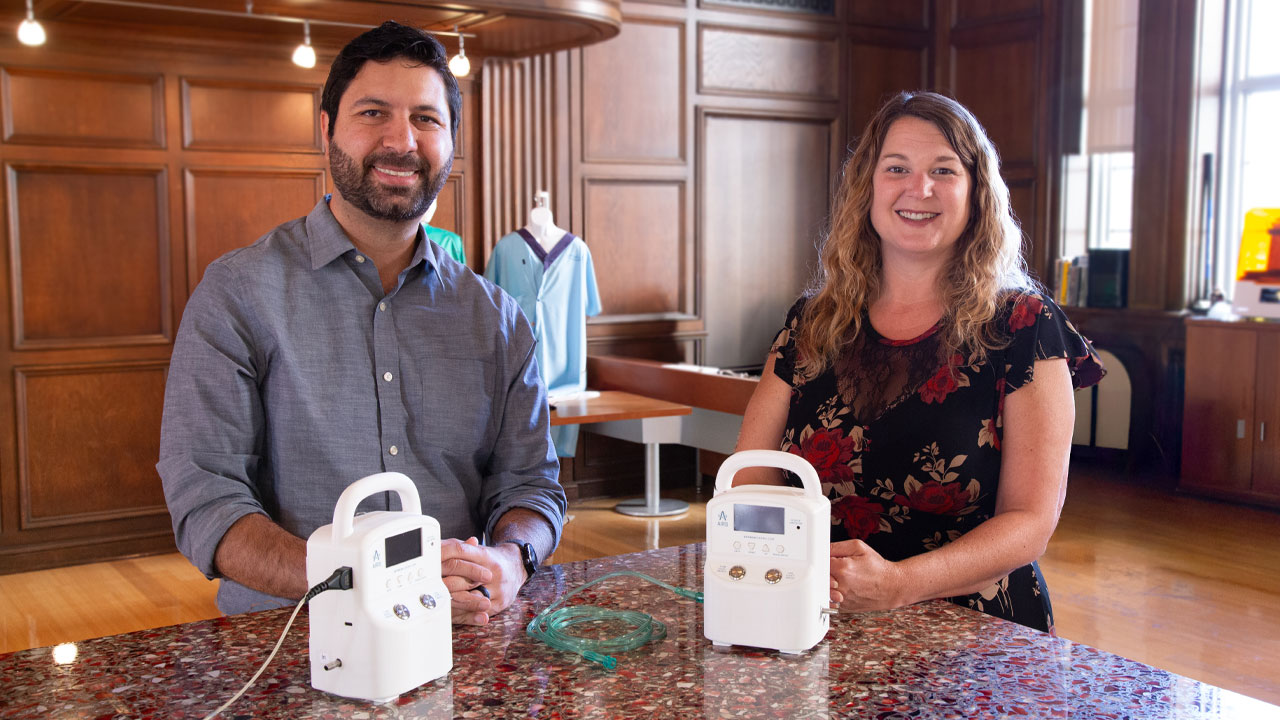
Built by a respiratory therapist, Michigan-based AIRS is transforming home oxygen therapy from static equipment into a system families and clinicians can monitor and trust.
When Valerie Obenchain talks about oxygen therapy, her language is clinical, precise—and deeply personal. For her, oxygen therapy is not an abstract market or passing trend. It’s something she has lived inside hospital rooms, witnessed in living rooms, and carried with her long after her shifts ended.
“The problem kept showing up in different ways,” she says. “I couldn’t accept that oxygen therapy basically went unmanaged once patients left the hospital.”
Inside hospitals, oxygen is treated as sacred. Machines hum and screens glow as respiratory therapists move with quiet efficiency, adjusting flow rates and catching subtle changes before they become serious. Outside those walls, equipment still runs, but oversight disappears, and patients are left to manage a life-sustaining therapy with little sense of whether it’s working as intended.
Obenchain didn’t have to imagine what that felt like. She watched it unfold in her own family when her grandmother developed Chronic Obstructive Pulmonary Disease (COPD)—a progressive lung disease that makes it hard to breathe—and became dependent on oxygen. Her grandmother was active and independent, but oxygen followed her everywhere. Tubing ran along furniture. Tanks were monitored with nervous glances. The cannula was checked again and again before leaving the house or turning in for the night.
There was no easy way to tell if something was wrong until it already was.
“She didn’t trust it,” Obenchain says. “Oxygen needs can change and our device is the first to monitor the oxygen supply and user. This helps ensure the proper amount of oxygen is being delivered.”
A System Built for Hospitals, Not Homes
After more than 20 years as a respiratory therapist, Obenchain saw firsthand how differently oxygen was treated once patients left the hospital.
“We had all this sophisticated technology in clinical settings,” she says, “but then people went home with the same old equipment and no visibility.”
The risks were not theoretical. She had seen tubing disconnect without anyone noticing. She had watched families rush loved ones back to emergency rooms after oxygen failures no system had noticed.
“I’ve had patients die from empty tanks and disconnected tubing,” she says quietly.
She didn’t approach this as an entrepreneur looking for an opportunity. She approached it as a clinician who could no longer accept how unsafe oxygen therapy had become outside the hospital.
Turning Oxygen Therapy Into a System
Obenchain founded AIRS (Advanced Interactive Response Systems) to address a single question: What would oxygen therapy look like if hospital-level awareness followed patients home?
AIRS built a connected monitoring platform that combines medical hardware, digital software, and remote clinical oversight. The system tracks oxygen flow, blood oxygen saturation, heart rate, and waveform quality—transforming oxygen therapy from something static into something responsive.
“We wanted people to be able to look at a screen and know what was happening in their body,” Obenchain says. “Not guess. Not worry. Know.”
Data flows through a platform monitored by licensed respiratory therapists who understand what the signals mean—and when to intervene. Patients receive alerts locally. Family members can check in remotely. Clinicians gain real-time insight instead of relying on check-ins weeks later.
Every element of AIRS was shaped through conversation with pulmonologists, respiratory therapists, oxygen suppliers, caregivers, and patients—people who understood both the frustration of uncertainty and the fear of equipment failure.
AIRS holds issued patents in 20 countries, but Obenchain measures success more simply: by whether people trust the technology when they sleep.
From Prototype to Patient Care
Today, AIRS has entered one of healthcare’s most demanding proving grounds: the hospital.
In partnership with Henry Ford Health, AIRS technology is being piloted in pulmonary rehabilitation settings where therapists use the system alongside current standards of care for patients under direct clinical supervision. Oxygen levels fluctuate as patients move. Systems update and data flows as clinicians refine protocols and feedback becomes immediate.
“Having the opportunity to generate clinical data is huge,” Obenchain says. “Henry Ford is a major hospital, and being able to work directly inside it has helped change the trajectory of our company.”
The goal is clinical validation and publication—essential milestones for any technology seeking to influence how care is delivered.
Redefining Oxygen’s Future
For Obenchain, the goal is personal and practical.
“If my grandmother had this, I could actually keep an eye on her,” she says. “I could log on anytime and see what her oxygen levels were and know everything was okay.”
She notes that new reimbursement pathways are beginning to support remote respiratory monitoring, removing one of the largest historical barriers to adoption.
Growing From Michigan, Looking Outward
Based in Newaygo, Michigan, AIRS has emerged from the state’s innovation ecosystem with support from the MSU Research Foundation’s Conquer Detroit Accelerator program, where Obenchain built the clinical partnerships needed to move the company from prototype to practice.
One of the most significant partnerships has been with Henry Ford Health, whose pulmonary rehabilitation program is now hosting AIRS’ pilot work—an uncommon opportunity for an early-stage company seeking to prove its place inside major healthcare systems. Through this pilot, Henry Ford Health can develop junior faculty, providing them industry research experience and mentorship from the Principal Investigator, Dr. Avi Cohen.
That hands-on environment has also prepared the company for its next phase. AIRS is working toward a 2026 launch of its first digital health system, building on an FDA-registered product already in distribution and a growing network of institutional partners.
Clinical validation, product refinement, and hospital integration now define the company’s daily work.
The opportunity is larger than one family’s experience. Millions of people rely on oxygen therapy, and AIRS is building carefully, one partnership at a time.
An Open Door
Obenchain continues to work alongside clinicians, researchers, and care teams who are ready to rethink oxygen therapy beyond hospital walls. If you work in respiratory care—or live alongside it—you’re already close to the problem AIRS is solving.
Learn more at oxygenalarms.com.
PHOTO: Valerie Obenchain, founder of AIRS (right), and Dr. Avi Cohen, M.D., interventional pulmonologist at Henry Ford Health and principal investigator on AIRS’ clinical pilot, are pictured with the AIRS connected oxygen monitoring devices. Photo courtesy of Henry Ford Health.
Written by Doug Snitgen.
Latest Posts

October 1, 2026

September 24, 2026